LIVE! #83
4 October 2026
Agenda
- Why We're Here / Roundtable Rules
- Introduction to Literary Forensics
- Group Discussion
- Further Study
Why We're Here
We writers want to improve our craft
by reading like a writer
We learn from each other
using Literary Forensics
Roundtable Rules
Always refer back to the book
Practice active listening & serendipity
Every feeling and observation is valid...
but not every conclusion
Always refer back to the book
Reading Teaches Writing
Meet today's author: Daniel Kraus
- Kraus was born in 1975 in Midland, Michigan, and grew up in Fairfield, Iowa: rural isolation and rough days at school. At age five he watched Night of the Living Dead with his mother; he has seen it some 300 times since, and wrote a 2026 memoir about it, Partially Devoured. By high school he was writing novel-length horror stories.
- He earned a B.A. in Communication Studies at the University of Iowa (1997). As a senior he made Jefftowne, a documentary about an Iowa City man with Down syndrome, then a Studs Terkel-inspired series of films about work: Sheriff (PBS Independent Lens), Musician (Chicago jazz saxophonist Ken Vandermark) and Professor (2010).
- He earned an M.S. in Library and Information Science at the University of Illinois (2005) and became the Books for Youth editor at Booklist.
- First novel: The Monster Variations (2009). Rotters (2011) and Scowler (2013) won Odyssey Awards (audiobooks narrated by Kirby Heyborne). He co-wrote Trollhunters (2015) and The Shape of Water (2018) with Guillermo del Toro, and finished George A. Romero's The Living Dead (2020) and Pay the Piper (2024). Whalefall (2023) won an Alex Award and is being filmed with Josh Brolin.
- 30+ books in every form - adult and YA novels, graphic novels, nonfiction, TV and film - translated into 25+ languages. He switches genres on purpose, and treats writing like a factory shift.
- Kraus lives in the Chicago area (Evanston) with his partner.
On good versus evil:
"I have endless interest in bad versus worse."
—Daniel Kraus
What do you feel?
What in the book elicited that feeling?
Every feeling and observation is valid...
but every conclusion should be questioned
We practice serendipity
- nothing is too crazy
Always refer back to the book
What do you notice?

Writing Angel Down
- Most of Kraus's ideas simmer for years, even decades; this one didn't, and he can't remember where it came from - he hopes to find the note someday. He has been fascinated with WWI since researching the ~100-page WWI section of The Death and Life of Zebulon Finch: millions dying over a few yards of ruined ground would look like a farce to an alien - or an angel - watching from above.
- His agent of 20 years, Richard Abate, pitched it as the option book after Whalefall. Atria editor Loan Le bought it on a one-page synopsis, with no pages - which she says almost never happens.
- Kraus is a plotter: 2-3 months of research (books and documentaries, no interviews), then about 5 months for the first draft, working from an outline plus "ancillary documents" - period slang, American, French and German weaponry, and an entire invented division with its full chain of command (Bagger's division never existed). He uses only a small part of it.
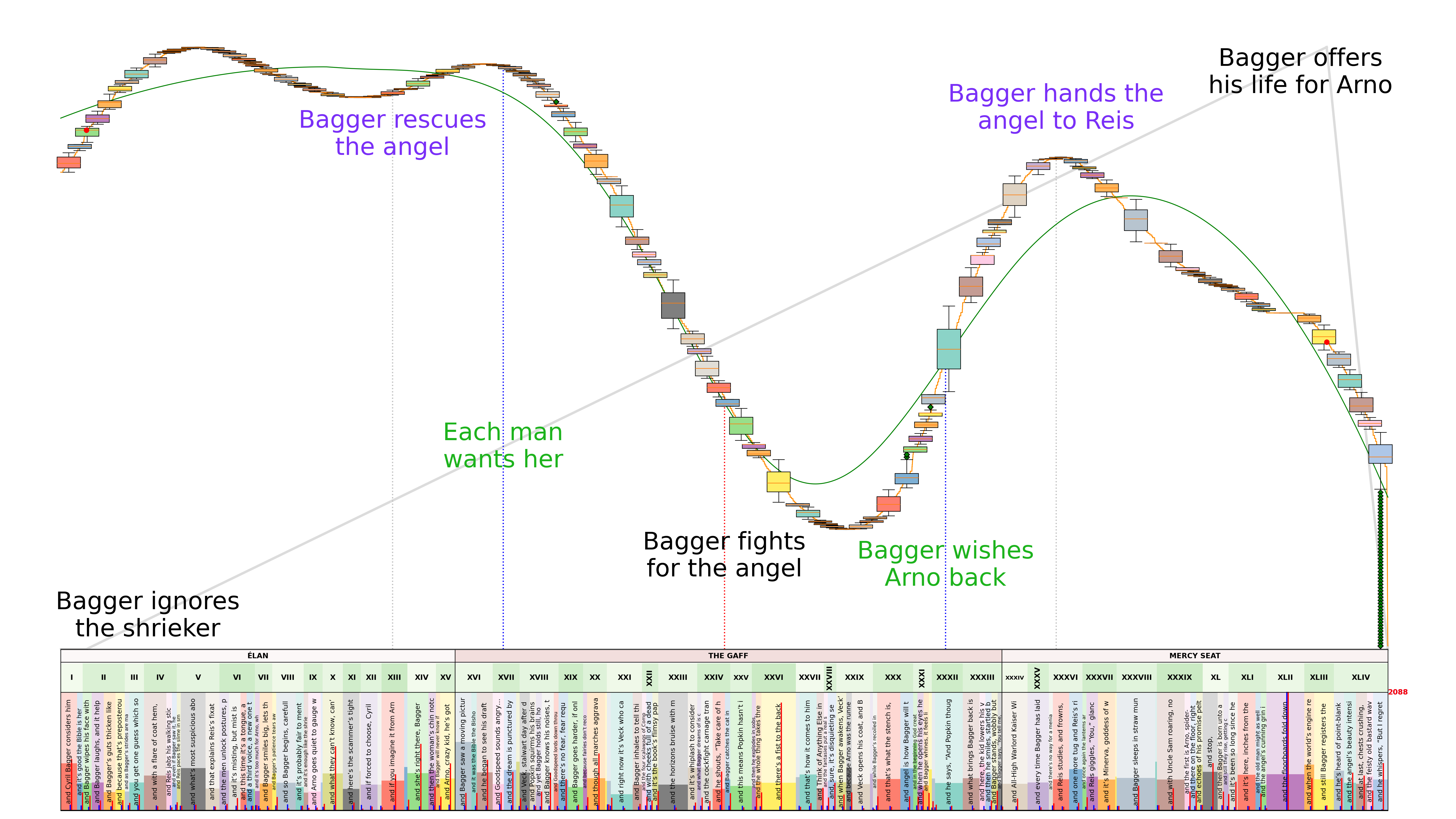
- The single sentence was not in the outline. It came to him while writing: WWI as a self-perpetuating killing machine, so the book loops - it starts mid-sentence and ends on a comma. Each session he re-read several pages to catch the rhythm again. The seed was Blood Sugar, where he first banned certain punctuation marks.
- He told no one, not even his editor. It was the first book since his debut that he was nervous handing in: he couldn't tell if it was brilliant or a disaster. It is now his favorite of all his books.
- Kraus deliberately limits research, likes characters readers wouldn't expect to sympathize with, and calls the ending a "big swing." Angel Down won the 2026 Pulitzer Prize for Fiction; Imagine Entertainment announced a film in January 2026.
Stats & Background
- Marketing: World War I Historical Fiction, Historical World War I Fiction, Military Thrillers
- Genre: Historical Magical-Realistic Long-Form Archplot
- Print Pages: 304; Word count: 70,617
Reading Grade: 16th; Avg. wds/sent.: 80.98
Lexical Density: 52.48; Flesch Reading Ease: 5.93 - POV: Bagger; Person: 3rd; Tense: Present
- Publish date: July 29, 2025
- Publisher: Atria Books, Simon & Schuster
- Audio book length: (8 hours, 28 mins)
- Narrator: Kirby Heyborne
- Recognition: 2026 Pulitzer Prize for Fiction, NYT Top 10 Books of 2025, NYT Notable Book of 2025, NYT Book Review Editors’ Choice, USA TODAY Bestseller, a Best Book of 2025 for People, Vulture and the Financial Times
- Pulitzer citation: “A breathless novel of World War I, a stylistic tour-de-force that blends such genres as allegory, magical realism and science fiction into a cohesive whole, told in a single sentence.”