LIVE! #78
1 March 2026
Agenda
- Why We're Here / Roundtable Rules
- Introduction to Literary Forensics
- Group Discussion
- Further Study
Why We're Here
We writers want to improve our craft
by reading like a writer
We learn from each other
using Literary Forensics
Roundtable Rules
Always refer back to the book
Practice active listening & serendipity
Every feeling and observation is valid...
but not every conclusion
Always refer back to the book
Reading Teaches Writing
Meet today's author: David Szalay
- Born in Montréal, Québec, to a Canadian mother and Hungarian father, Szalay grew up in London, England.
- After an English degree from Oxford, Szalay worked in various sales jobs in London, and wrote radio dramas for the BBC.
- Since turning to fiction-writing full-time, Szalay has lived in Brussels, Pécs, Hungary, and now in Vienna, Austria with his family.
- Szalay's debut novel, London and the South-East (2008), won the Betty Trask Award and the Geoffrey Faber Memorial Prize.
- He followed this with The Innocent (2009), Spring (2011), and All That Man Is (2016), a linked collection of nine stories that was shortlisted for the Booker Prize and won the Gordon Burn Prize.
- His 2018 book Turbulence—also structured as interconnected narratives—originated from a series of short pieces for BBC Radio 4.
- Flesh (2025), Szalay's sixth work of fiction, won the Booker Prize.
"I wanted to write a book that had a great sort of
realism in terms of its portrayal of the world as it is."
—David Szalay
"There is a lot about the character that we are not
told and that the reader themselves has to supply."
—David Szalay
What do you feel?
What in the book elicited that feeling?
Every feeling and observation is valid...
but every conclusion should be questioned
We practice serendipity
- nothing is too crazy
Always refer back to the book
What do you notice?

Writing Flesh
- David Szalay has described Flesh as “a short story collection hiding within a novel”.
- He wanted to write about a character that moves from Hungary to London, about being an outsider in two locales he is intimately familiar with.
- He wrote Chapter 1 before knowing where his story would lead.
- He explicitly omitted István's father, because he didn't want readers psychoanalyzing his protagonist.
- Needs to have a strong feel for the character (voice) before writing, but that doesn't necessarily direct what they do or does he know where they will go.
- To create his characters, Szalay likes to start with someone he already knows, but doesn't know well, perhaps hardly at all. He finds this a useful jumping-off point to create a character.
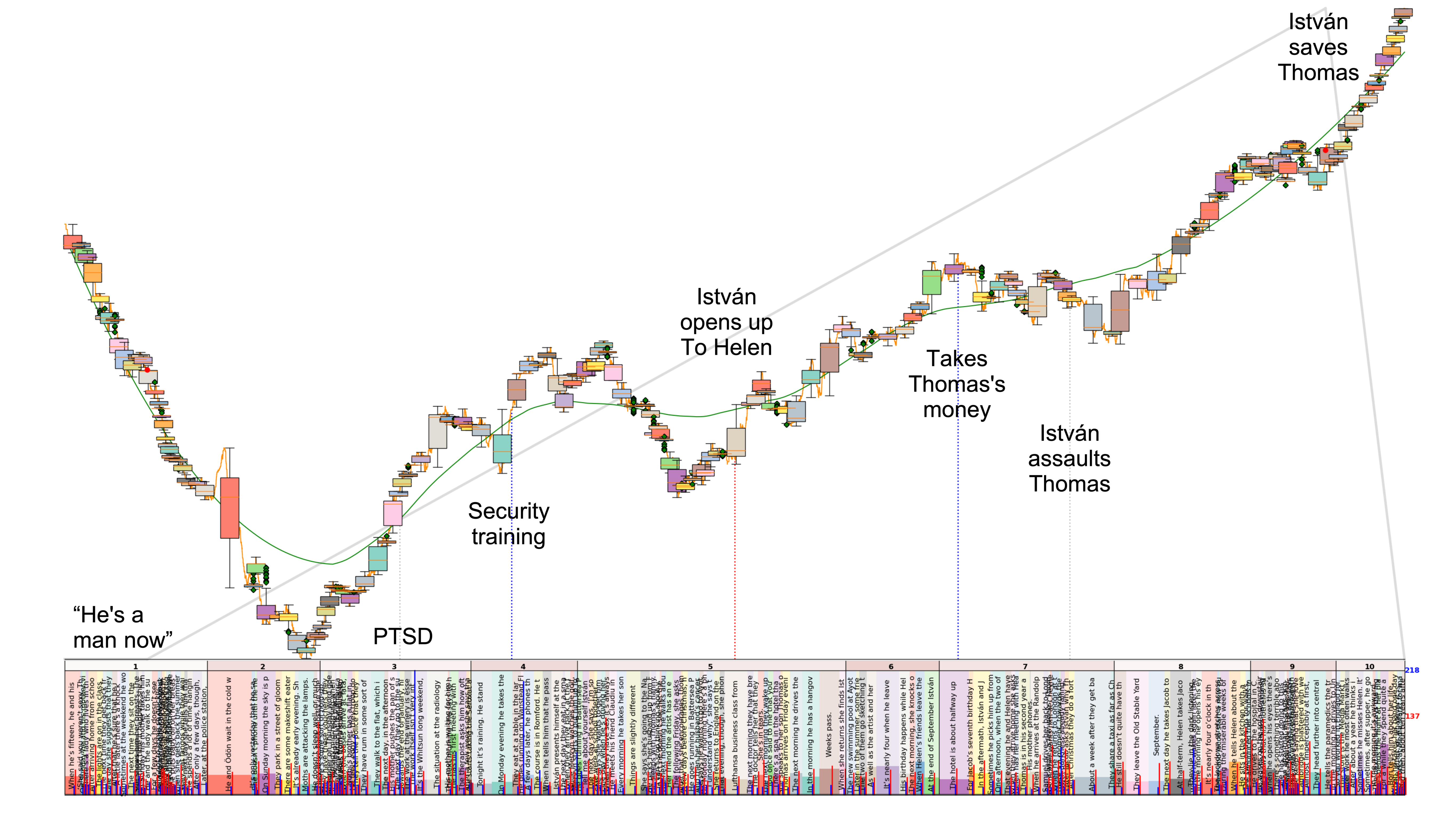
- Szalay says that he doesn't begin writing before knowing how his story will end, but he doesn't map out everything. For example, he knew that István would save Thomas and not let him die.
Stats & Background
- Marketing: Friendship Fiction, Family Life Fiction, Literary Fiction, Psychological Literary Fiction, Contemporary Literary Fiction
- Genre: Present-Day Realistic Long-Form Archplot
- Print Pages: 368; Word count: 84,739
Reading Grade: 6th; Avg. wds/sent.: 9.09
Lexical Density: 44.24; Flesch Reading Ease: 84.33 - POV: Omniscient (mostly István); Person: 3rd; Tense: Present
- Publish date: April 1, 2025
- Publisher: Scribner
- Audio book length: (9 hours, 36 mins)
- Narrator: Daniel Weyman
- Recognition: 2025 Booker Prize Winner (1st Hungarian-Brit to win), Kirkus Prize finalist, Carnegie Medal for Excellence longlist