LIVE! #30
4 April 2021
Agenda
- Why We're Here / Roundtable Rules
- Introduction to Literary Forensics
- Group Discussion
- Further Study
Why We're Here
We writers want to improve our craft
by reading like a writer
We learn from each other
using Literary Forensics
Roundtable Rules
Always refer back to the book
Practice active listening & serendipity
Every feeling and observation is valid...
but not every conclusion
Always refer back to the book
Reading Teaches Writing
Today's author: Colum McCann
- “I’m not interested, and neither are they, in the absoluteness of facts.
Facts are mercenary things. Facts can be used, they can be soldiers for whatever
sort of truth that you want them to be. Texture, emotional texture, heart. That’s a completely
different thing and that’s what I was going for: to try to capture the emotions that they
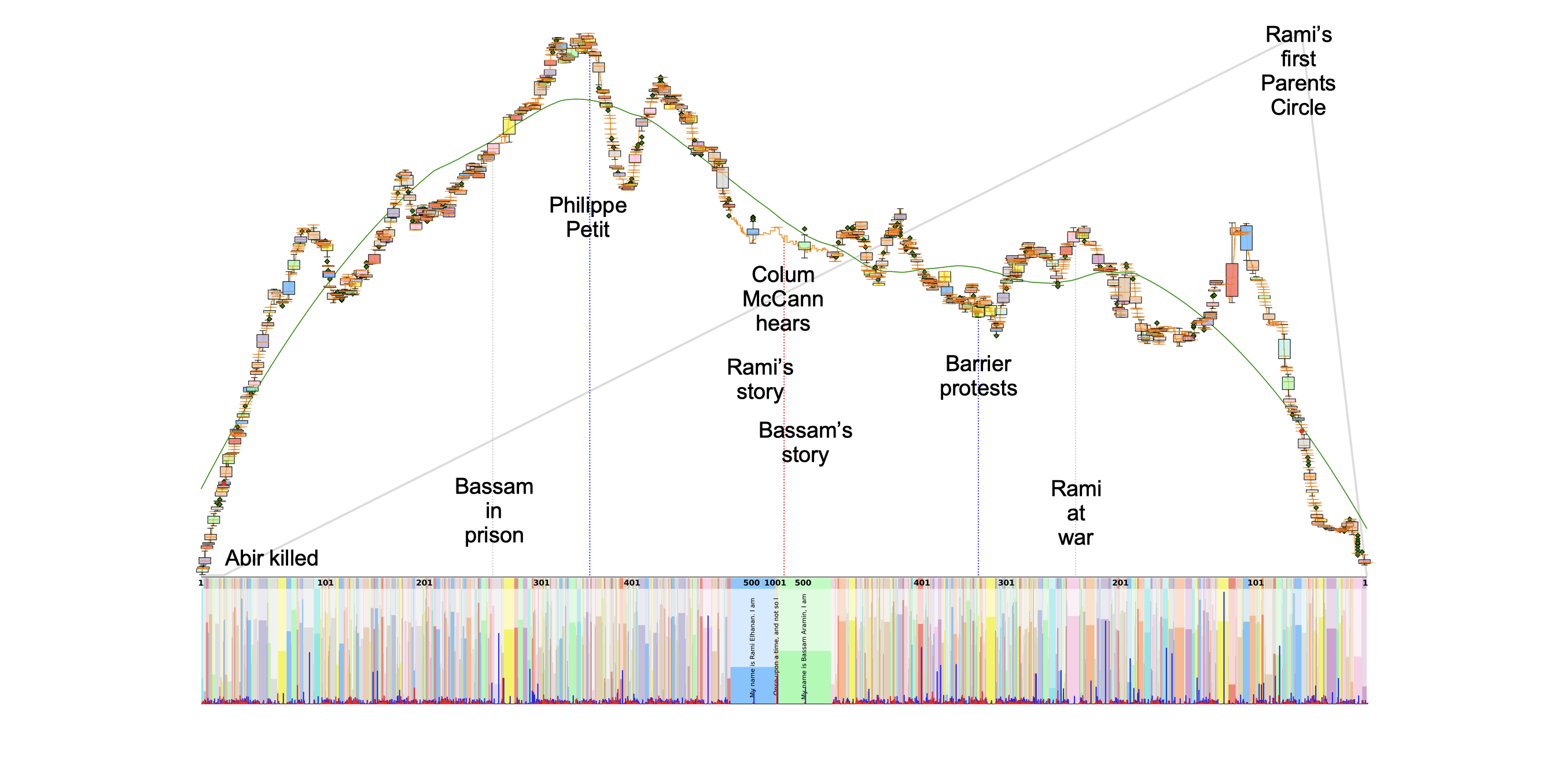
have and continue to have . . . “ - Colum McCann - On 1001 sections: A novel for the internet age, the way our minds work right now,
the weird shotgun leaps that we make from one age to the next . . . - McCann intends Apeirogon to mean that we’re all involved or complicit in a way
- McCann started confused, and he wants the reader to be confused,
because he believes that its okay to be confused . . . - “The purpose of the first 30-40 pages is to confuse the reader,
and then acknowledge that confusion.” - Colum McCann
What do you feel?
What in the book elicited that feeling?
Every feeling and observation is valid...
but every conclusion should be questioned
We practice serendipity
- nothing is too crazy
Always refer back to the book
What do you notice?

Apeirogon - Stats
- Marketing: Jewish Historical Fiction, Biographical Fiction, Biographical Historical Fiction
- Genre: Realistic Present-Day Episodic Long-Form
- Word count: 129,420
- Print Pages: 480
- Reading Level: 8th-9th grade
- Publish date: February 25, 2020
- Publisher: Random House
- Sold By: Random House
- Audio book narration: Colum McCann
- Prizes: Winner 2020 National Jewish Book Award; 2020 Booker Prize Longlist
- A Best Book of the Year: The Independent, NY Public Library, Library Journal
- Fiction vs. Non-Fiction
- - McCann prefers "storytelling"
- - 12.9% of first half is Bassam-Rami narrative
- Fiction using real people
- - Movies, TV feature the living
- - Books usually feature the dead
- Why is that?